Basic Application Architecture
Developer Perspective
A typical application is composed of:
- Build & Deploy Layer — CI/CD pipeline
- Server Layer — handles incoming requests
- Storage Layer — persists application data (can be external)
- Logging Storage Server — logs all events
- Metric Storage Server — logs all metrics
- Alert Server — alerts when something goes down
User Perspective
Users simply make requests to the server and receive responses.
Scaling
- Vertical Scaling: add more physical resources (CPU, RAM) to a single server
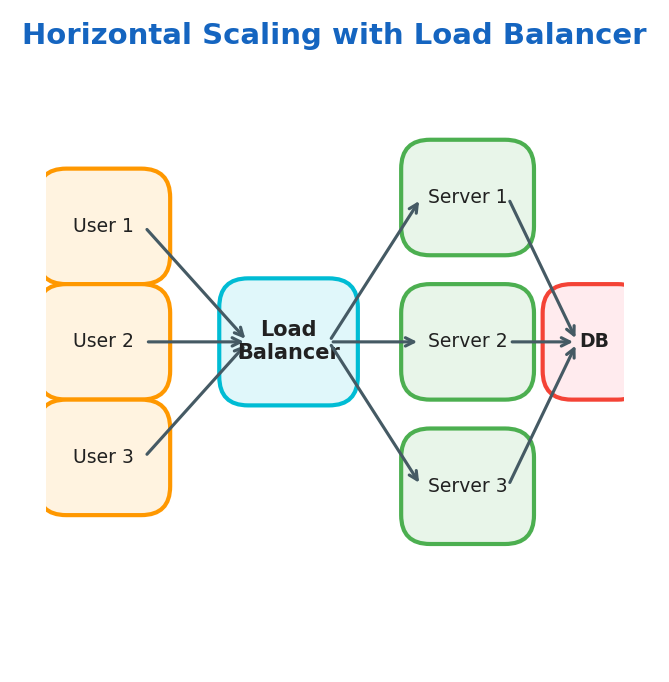
- Horizontal Scaling: add more servers to distribute the load
- Load Balancer: distributes traffic between multiple servers
Design Requirements
How We Handle Data
| Concern | Description |
|---|---|
| Move data | Data moves between servers in different parts of the world |
| Store data | How we persist our data |
| Transform data | Transforming data to answer queries or perform computations |
Metrics for Evaluating Our Design
Availability — measures uptime of a system:
$$\text{Availability} = \frac{\text{uptime}}{\text{uptime} + \text{downtime}}$$Example:
$$\frac{23 \text{ hours}}{23 \text{ hours} + 1 \text{ hour}} = 96\%$$SLI — Service Level Indicator: measures performance of a system
SLO — Service Level Objective: target goals for SLI (e.g., 99.9% availability)
SLA — Service Level Agreement: contracts with customers for SLO
Reliability — measures the probability of a system failing
Fault Tolerance — measures how much our system can continue working under failure
Redundancy — measures how much our system is replicated
Throughput — measures the number of operations in a time frame:
$$\text{Throughput} = \frac{\text{operations}}{\text{time}} = \frac{\text{queries}}{\text{seconds}} = \frac{\text{bytes}}{\text{seconds}}$$Latency — measures how long it takes to complete a request
Networks
Basics
| Concept | Description |
|---|---|
| Packages | Encapsulate data to be transferred over the network |
| IP Address | Virtual identification of a host |
| MAC Address | Physical identification of a host |
| NAT | Translates public IP to private within a LAN. Devices in a LAN have their own private IPs and access the internet using a single public IP |
| Port Forwarding | Network technique that enables external users to access specific services on a private, local network |
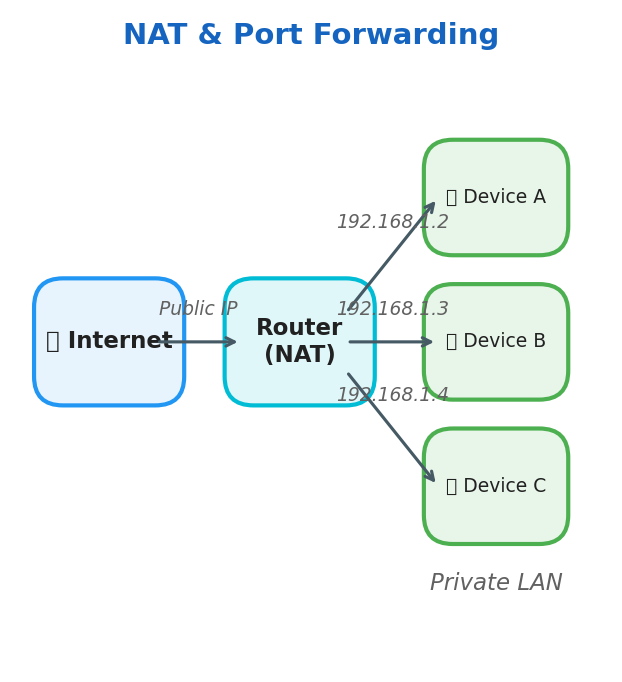
Router — sends packages across the network
Basic Protocols
| Protocol | Description |
|---|---|
| HTTP | Exchange hyper-text information |
| SSH | Remote connection to a host |
| TCP | Stateful communication, 3-way handshake, congestion handling, retransmission of lost packages |
| UDP | Non-stateful communication, no guarantees |
API Design
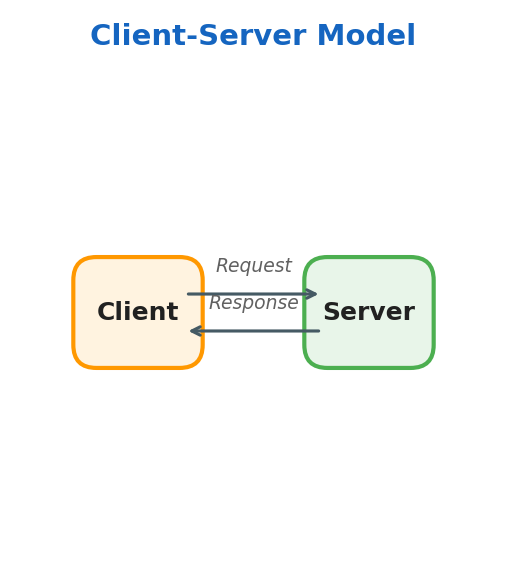
Client-Server Model
- Client — accesses information provided by a server
- Server — provides resources
RPC — Remote Procedure Call
The RPC model allows a program to execute code in a different machine or address space.
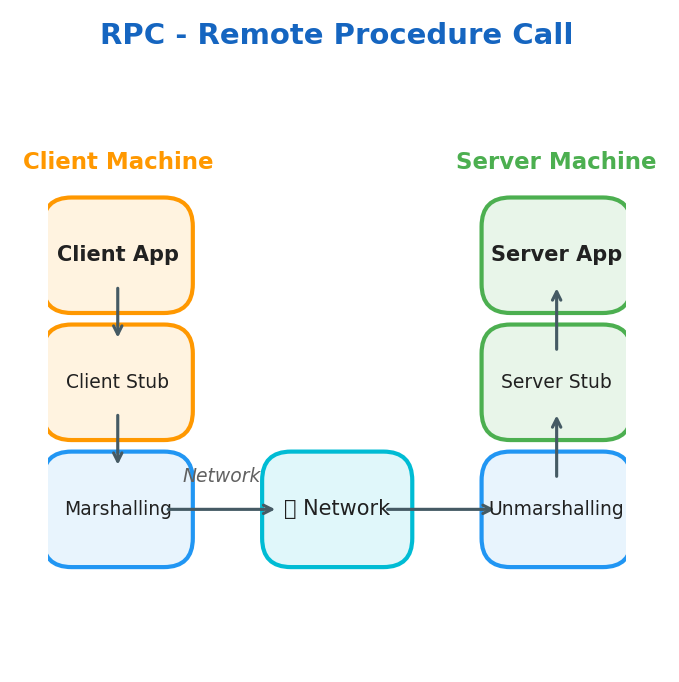
Key concepts:
- Stub — function proxy on both local and remote server
- Marshalling — packaging parameters into a message ready to be sent
- Unmarshalling — unpacking parameters from the received message
HTTP / HTTPS
HTTP is the protocol for client-server communication. TLS/SSL encrypts traffic between client and server.
Methods:
| Method | Purpose |
|---|---|
| GET | Retrieve resources |
| POST | Create resources |
| PUT | Update/replace resources |
| DELETE | Remove resources |
Status Codes:
| Range | Meaning |
|---|---|
| 1xx | Informational |
| 2xx | Successful |
| 3xx | Redirection |
| 4xx | Client Error |
| 5xx | Server Error |
Cons: HTTP is not ideal for real-time data exchange
WebSockets
WebSockets establish a persistent, full-duplex connection between client and server — unlike REST where each request creates a new connection.
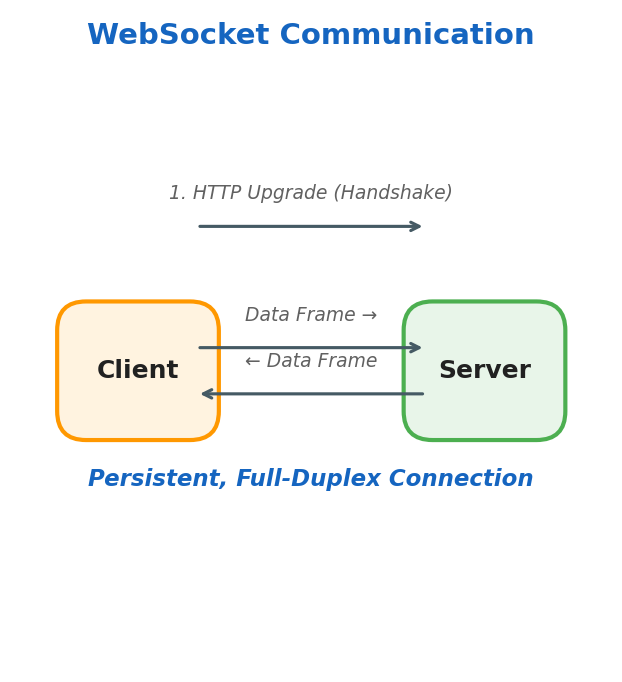
Pros:
- Bi-directional communication
- Great for real-time data (chat, live feeds)
- Supports server push and polling
API Paradigms
REST
- Stateless — server doesn’t maintain session state
- Pagination — page through resources
- Cacheable — responses can be cached
- Resource-identified — resources have unique URIs, exchanged in JSON
- Layered — client and server are decoupled; can talk to replicas transparently
GraphQL
- Uses only POST requests
- Body contains queries for fetching data
- Less cacheable compared to REST
gRPC
- Typically used for server-to-server communication
- Implements RPC with schema-defined data
- Faster than REST
- Supports bi-directional streaming
- Uses exceptions instead of status codes
- Built on HTTP/2
API Design Best Practices
API Contract — defines the structure of your API
Handling API changes:
- Adding parameters → make them optional
- Removing parameters → can break external customers
Pagination — limit the number of returned objects:
GET https://api.example.com/v1/users/:id/tweets?limit=10&offset=0
HTTP Idempotency — making the same request multiple times produces the same effect:
| Method | Idempotent? |
|---|---|
| GET | ✅ Yes |
| PUT | ✅ Yes |
| DELETE | ✅ Yes |
| POST | ⚠️ Depends on implementation |
Caching
Basics of Cache
| Term | Description |
|---|---|
| Cache Hit | Data is found in cache |
| Cache Miss | Data is not in cache or is expired |
| Cache TTL | Maximum time data can stay in cache |
| Cache Stale | Maximum age of expired data |
Cache Hit Ratio:
$$\text{Cache Ratio} = \frac{\text{hits}}{\text{hits} + \text{misses}}$$Client-Side Caching
- Check memory cache first
- Cache miss → check disk cache
- Cache miss → make network request
Server-Side Caching Strategies
Read Through
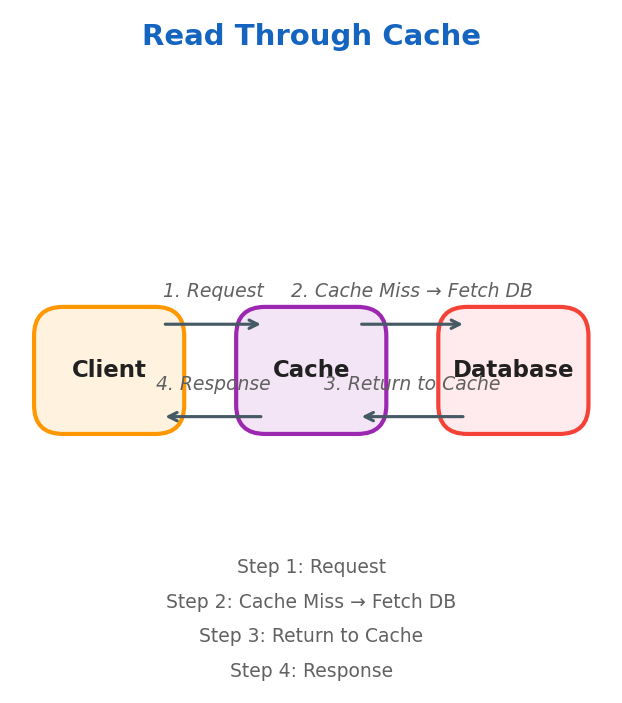
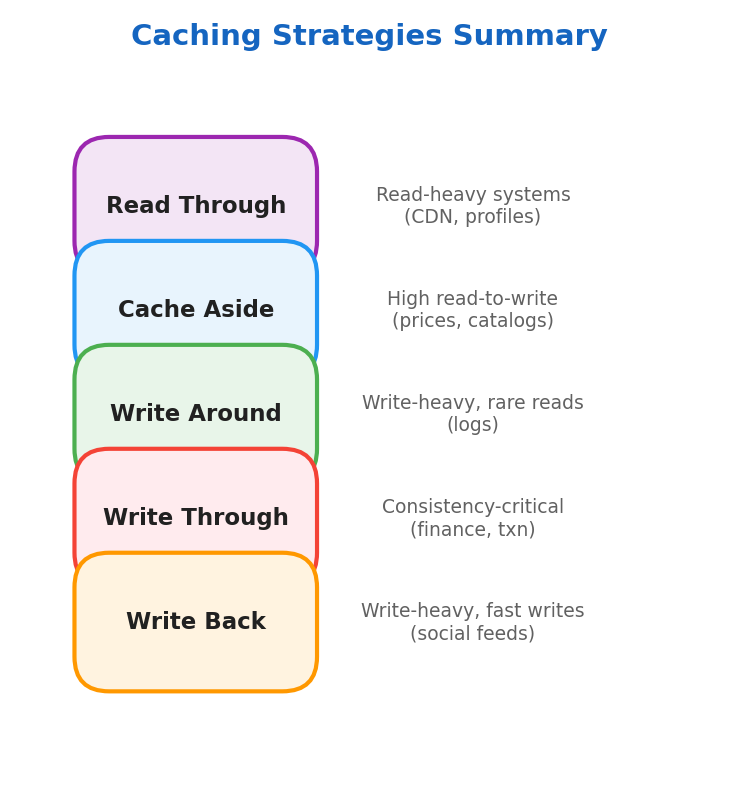
Best for read-heavy systems: CDNs, social media feeds, user profiles.
Cache Aside (Lazy Loading)
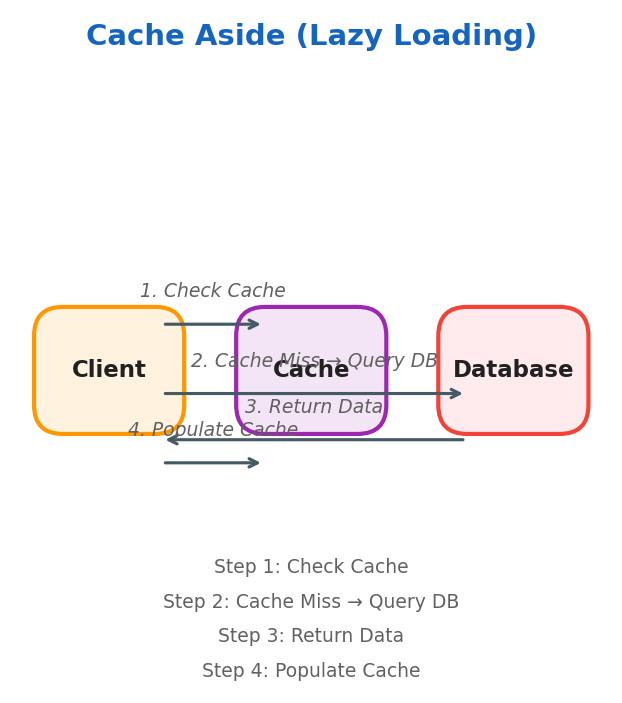
Data is stored in cache only when needed. Best for systems with high read-to-write ratio (prices, descriptions, stock status).
Write Around
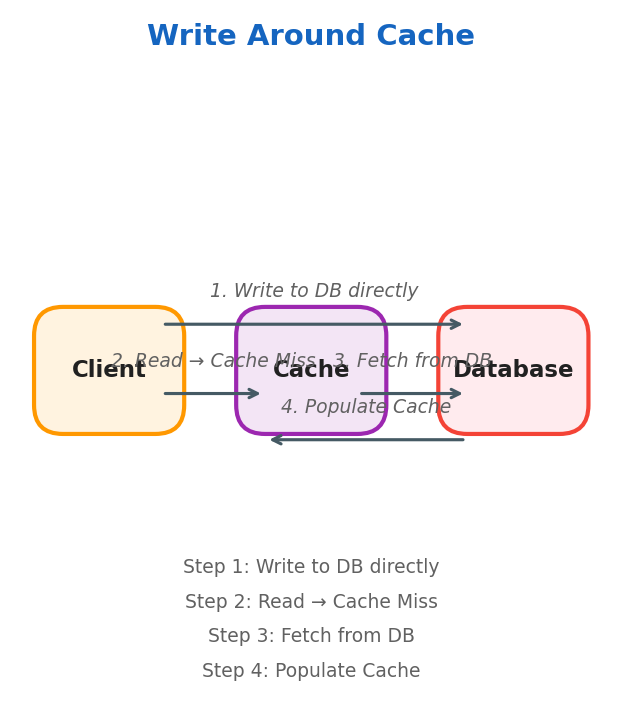
Only frequently accessed data resides in cache. Best for write-heavy systems where data is not immediately read (logging systems).
Write Through
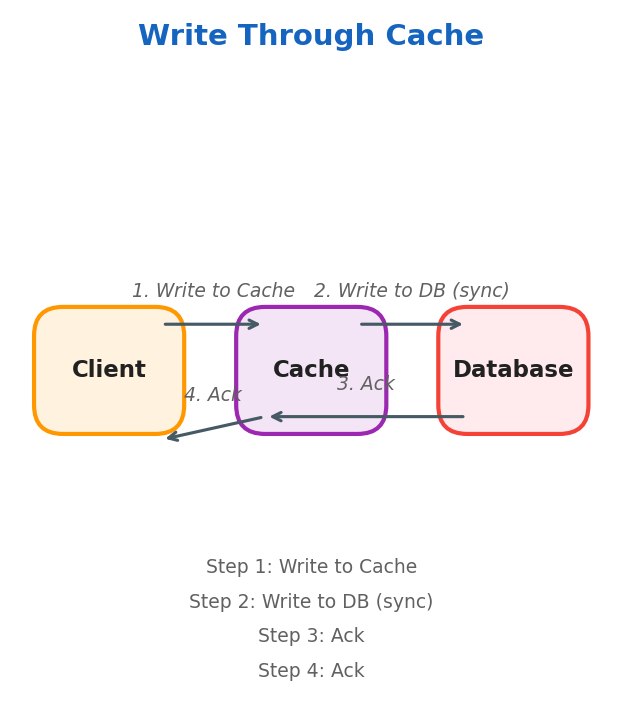
DB and cache are kept in sync. Best for consistency-critical systems — financial applications, online transaction processing.
Write Back
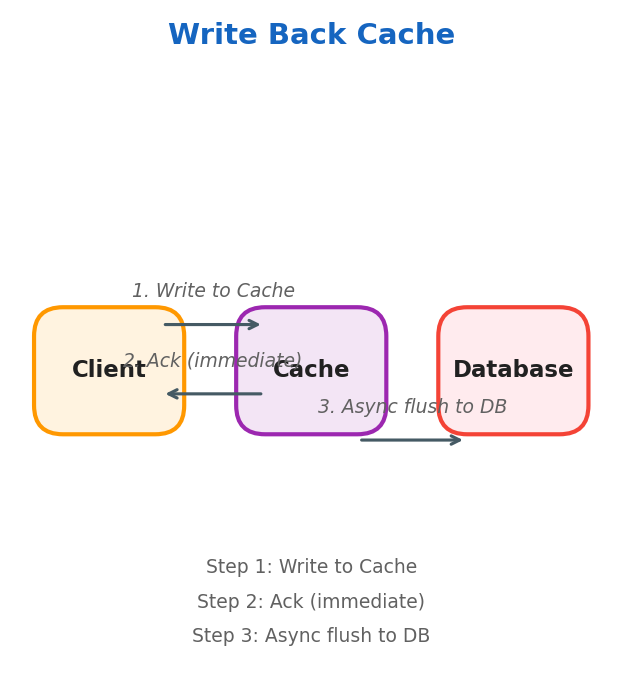
Writes go to cache first, then asynchronously flushed to the database. Ideal for write-heavy scenarios where immediate consistency isn’t critical (logging, social media feeds).
Strategies Summary
Cache Eviction Policies
Eviction Policies determine which elements are removed when the cache is full.
FIFO (First In, First Out)
Implemented with a queue. The oldest item is evicted first.
LRU (Least Recently Used)
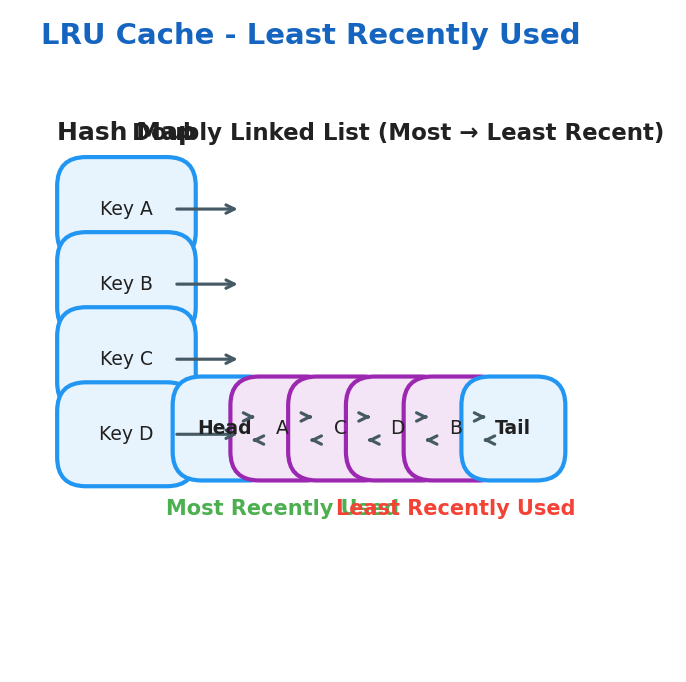
Uses a Hash Map + Doubly Linked List:
- Hash Map: key → pointer to a node in the linked list
- Doubly Linked List: maintains access order (head = most recently accessed)
LFU (Least Frequently Used)
Uses two maps and a frequency tracker:
key_map: key → nodefreq_map: frequency → doubly linked list of nodesmin_freq: integer tracking the minimum frequency
            key_map
    ┌────────────────────┐
    │ A → Node(freq=3)   │
    │ B → Node(freq=1)   │
    │ C → Node(freq=1)   │
    │ D → Node(freq=2)   │
    └─────────┬──────────┘
              │
              ▼
          freq_map
┌─────────────────────────────────┐
│  freq = 1 → [HEAD ⇄ C ⇄ B ⇄ TAIL] │
│              ↑MRU   ↑LRU           │
│  freq = 2 → [HEAD ⇄ D ⇄ TAIL]     │
│  freq = 3 → [HEAD ⇄ A ⇄ TAIL]     │
└─────────────────────────────────┘
  min_freq = 1
CDN (Content Delivery Network)
CDN Servers are groups of static content cache servers placed close to end users for low latency.
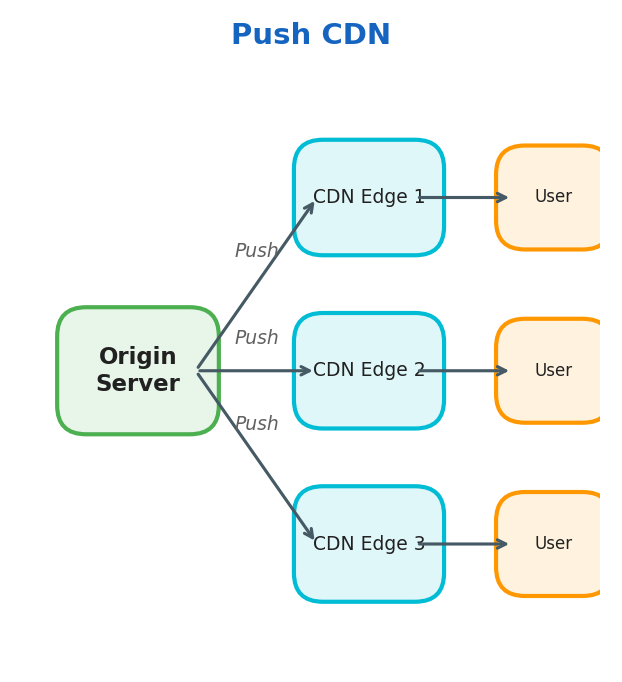
Push CDN
The origin server pushes data to CDN edge nodes proactively.
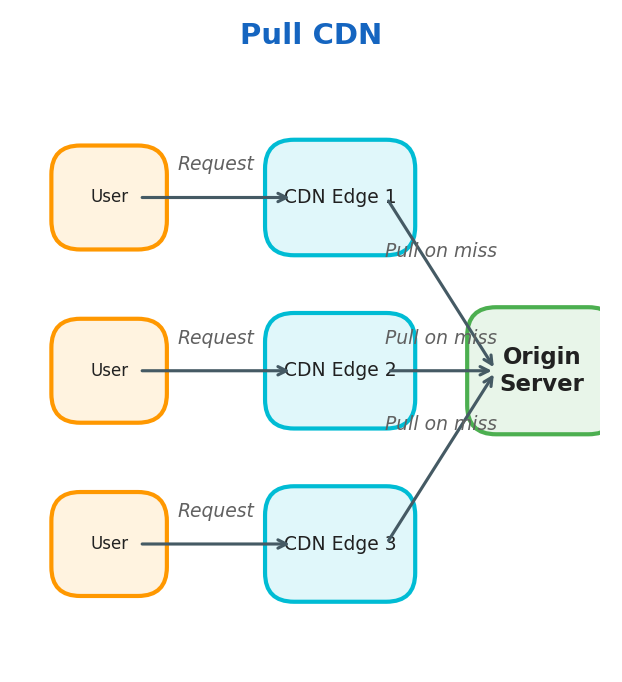
Pull CDN
CDN edge nodes pull data from the origin server on cache miss.
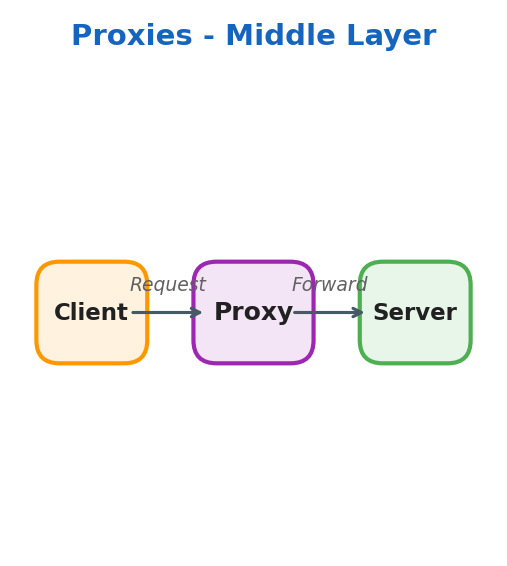
Proxies
Proxies are a middle layer between client and server.
Forward Proxy
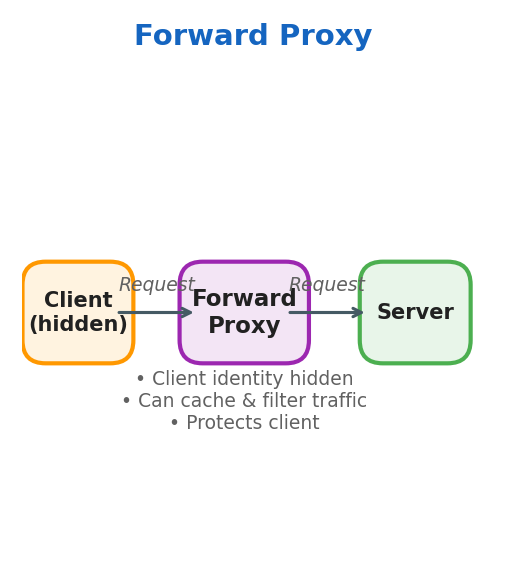
- Client identity is hidden from the server
- Proxy can cache results and filter traffic
- Protects the client
Reverse Proxy
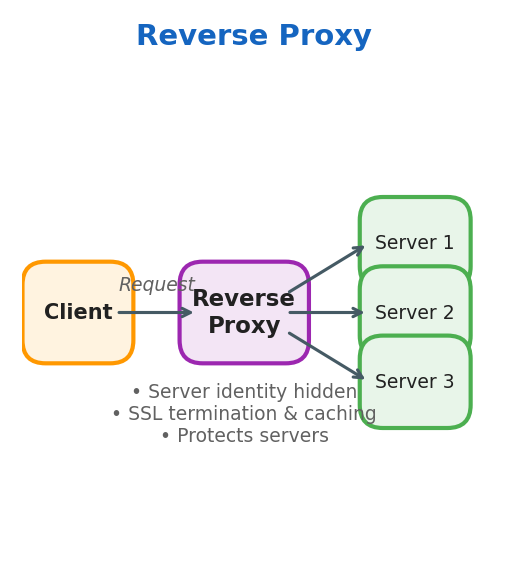
- Server identity is hidden from the client
- Proxy forwards requests to the correct backend server
- Handles SSL termination and caching
- Protects the servers
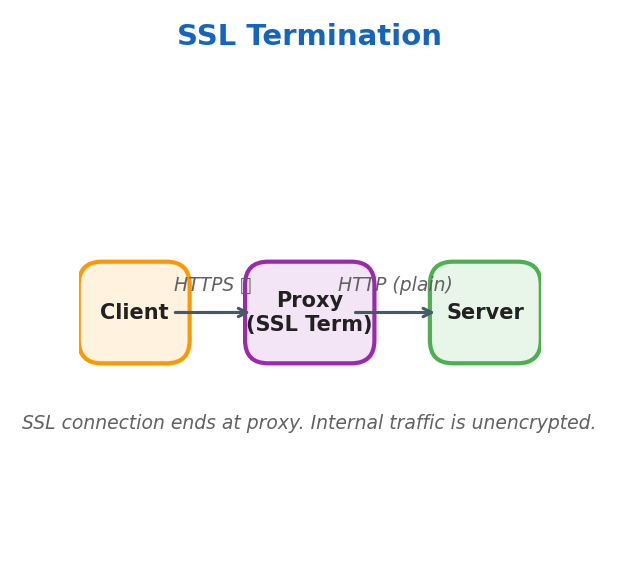
SSL Termination
SSL connection ends at the proxy. Internal traffic from proxy to server uses plain HTTP.
SSL Pass Through
All traffic remains encrypted end-to-end. The proxy forwards encrypted traffic without decrypting.
Load Balancer
A load balancer is a reverse proxy that distributes traffic to backend servers.
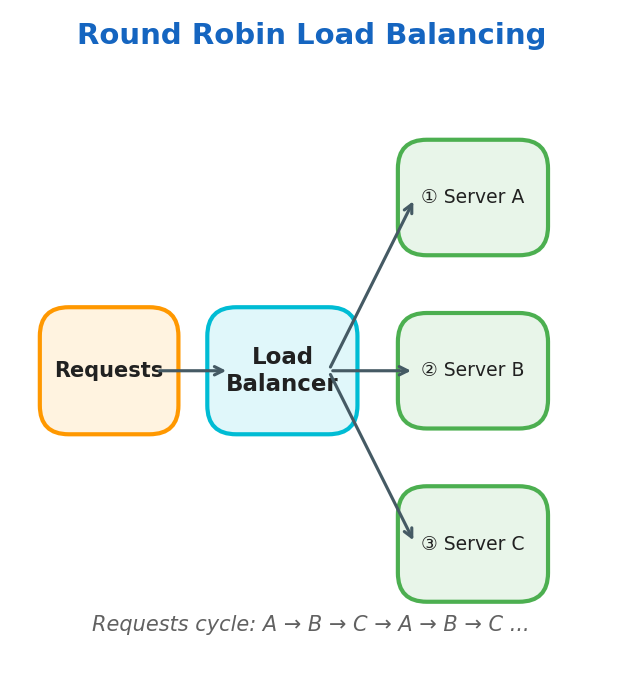
Round Robin
Requests cycle through servers in order: A → B → C → A → B → C…
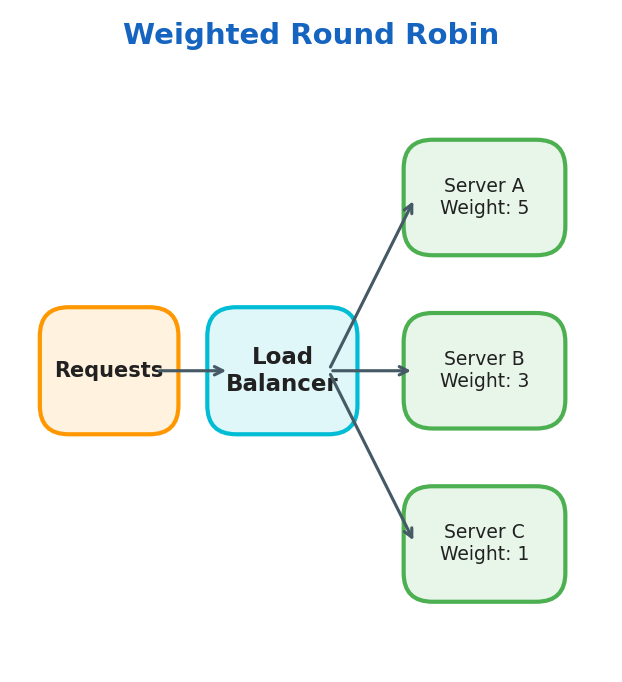
Weighted Round Robin
Same circular pattern, but servers with higher weight receive proportionally more traffic.
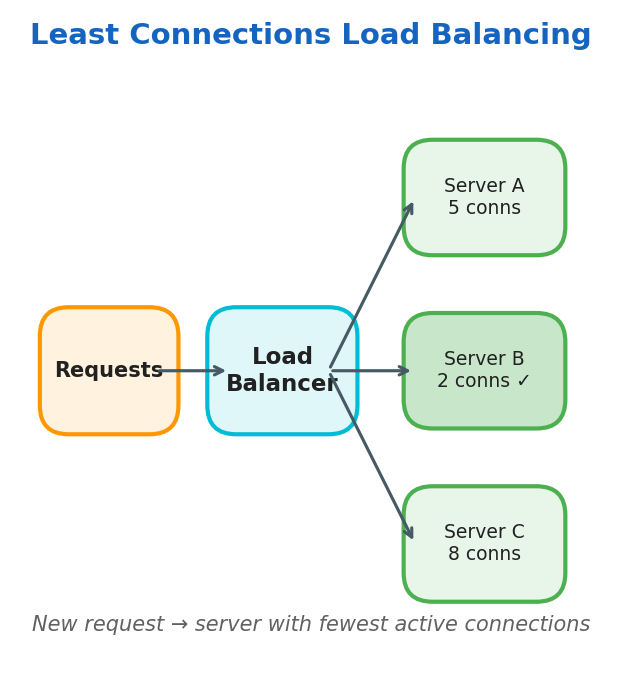
Least Connections
Routes new requests to the server with the fewest active connections.
User Location
Routes based on the user’s geographic location for lowest latency.
Regular Hashing
Same IP always maps to the same server:
$$\text{Dest-Server} = \text{Client-IP} \mod N_{\text{servers}}$$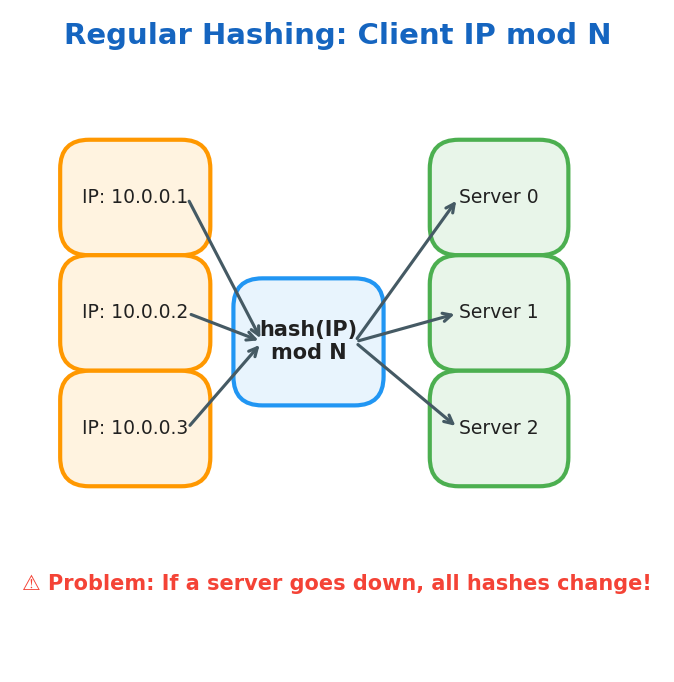
Problem: If a server goes down, all hash mappings need to be recalculated.
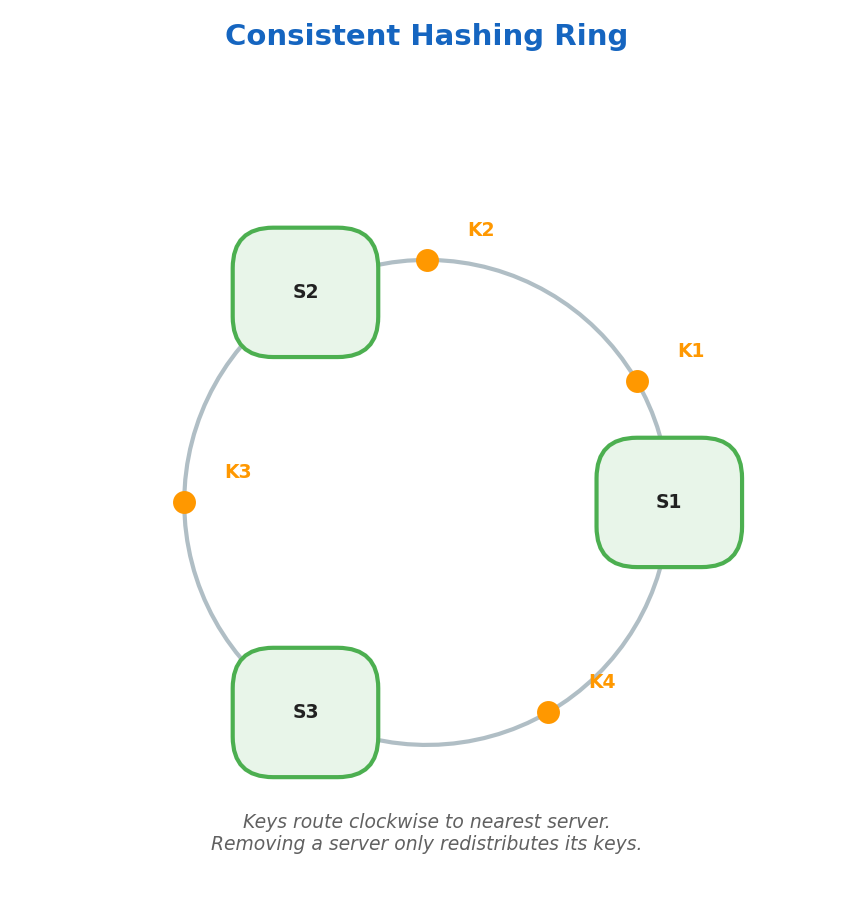
Consistent Hashing
Servers and keys are mapped onto a hash ring. Keys route clockwise to the nearest server. When a server is removed, only its keys are redistributed.
Layer 4 vs Layer 7 Load Balancing
| Type | Level | Speed | Intelligence |
|---|---|---|---|
| Layer 4 | Transport (TCP/UDP) | Faster | Basic routing |
| Layer 7 | Application (HTTP) | Slower | Content-aware routing |
Storage
RDBMS (Relational Databases)
SQL is the language to query relational databases. Data is stored in tables on disk.
B+ Tree Index
Relational databases implement indexing using B+ Trees for O(log n) I/O operations.
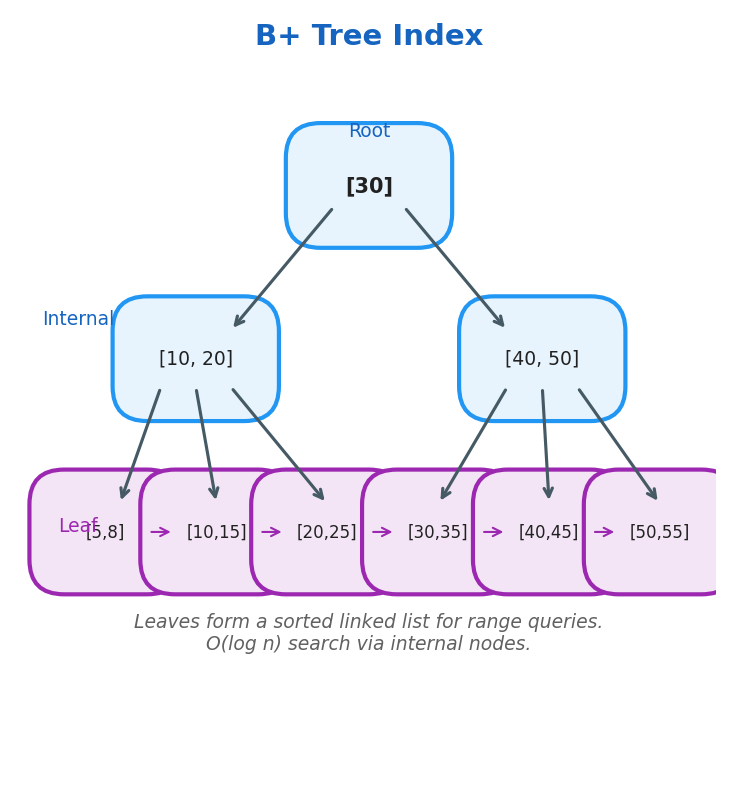
Key properties:
- Every node can have m children
- Each node has m-1 values
- Data is stored only on leaf nodes
- Leaf level forms a sorted linked list
- Root/internal nodes are used to efficiently locate data on leaf nodes
Table Structure
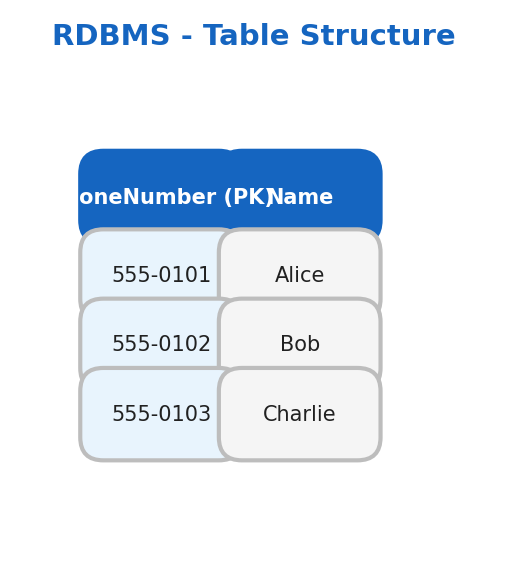
Data Schema defines how data is structured:
CREATE TABLE People (
    PhoneNumber int PRIMARY KEY,
    Name varchar(100)
);
Foreign Keys link two tables together. Joins combine tables based on conditions.
ACID Properties
| Property | Description |
|---|---|
| Atomicity | Transaction is all-or-nothing. If any step fails, the entire transaction rolls back |
| Consistency | Transactions only bring the DB from one consistent state to another |
| Isolation | Concurrent transactions execute as if running in isolation |
| Durability | Once committed, data persists even after system failure (stored on disk) |
NoSQL
| Type | Description | Examples |
|---|---|---|
| Key-Value | Stores data as key-value pairs | Redis, Memcached, etcd |
| Document | Stores data as JSON documents | MongoDB |
| Wide-Column | Stores data in columns instead of rows | Cassandra, Google Bigtable |
| Graph | Stores data as relationships between objects | Neo4j |
BASE Properties
| Property | Description |
|---|---|
| Basically Available | All users can access the database concurrently |
| Soft State | Data can have multiple intermediate states |
| Eventually Consistent | Consistency is achieved once all replicas are updated |
Eventually Consistent vs Strict Consistency
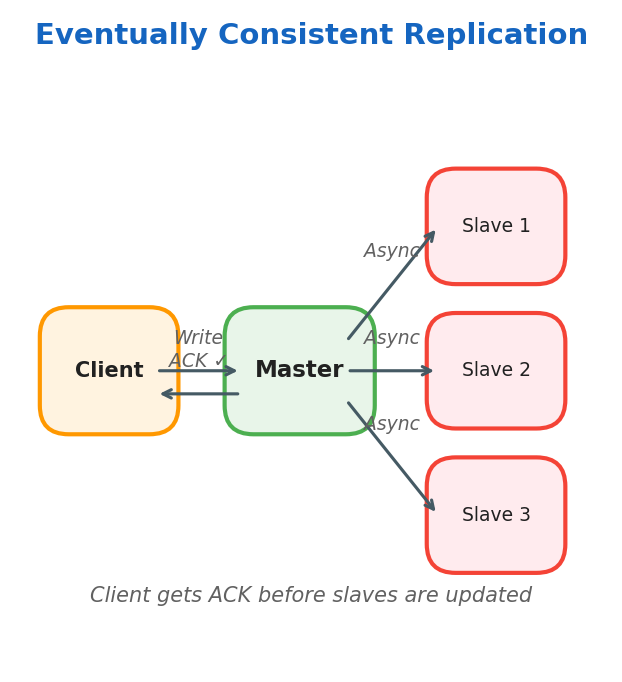
Eventually Consistent: Client writes to the master node and receives ACK immediately. The master node updates slaves asynchronously.
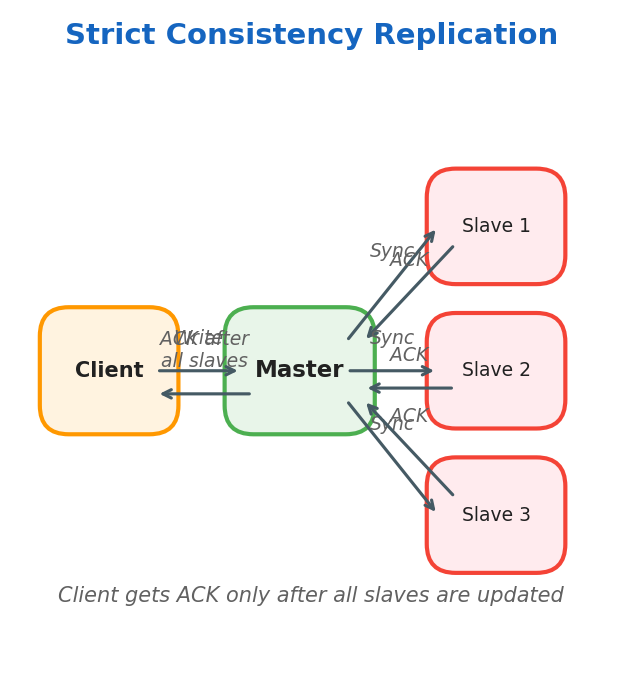
Strictly Consistent: Data is written to the master and immediately copied to all slaves. Client receives ACK only after all slaves confirm.
Replication and Sharding
Synchronous Replication
Master replicates data on slaves at write time. Used when critical consistency is needed.
Asynchronous Replication
Master replicates data on slaves later. Used when consistency can be eventually achieved.
Master-Master Replication
Multiple masters replicate each other and each replicates its own slaves. Ideal for multi-region setups with one master per region.
Sharding
Sharding divides data into partitions based on a shard key.
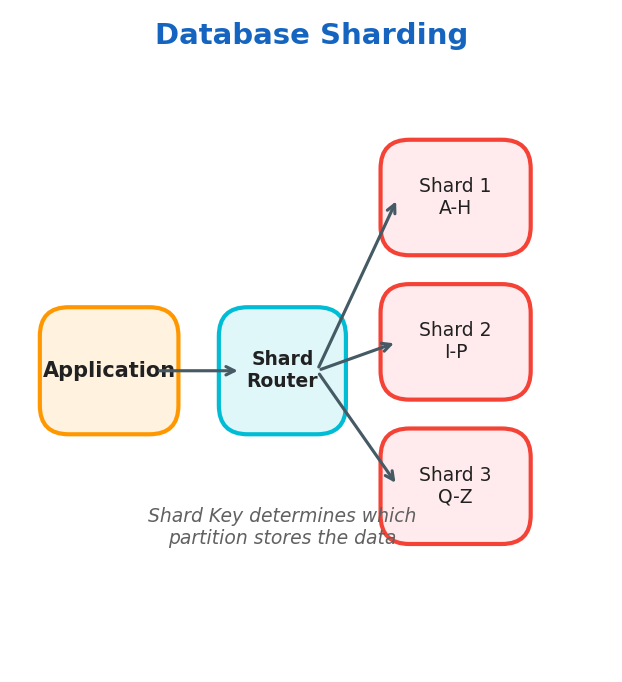
Use cases: massive, high-traffic systems
- Relational databases — sharding is done at the application level
- NoSQL databases — horizontal scaling per shard
CAP Theorem
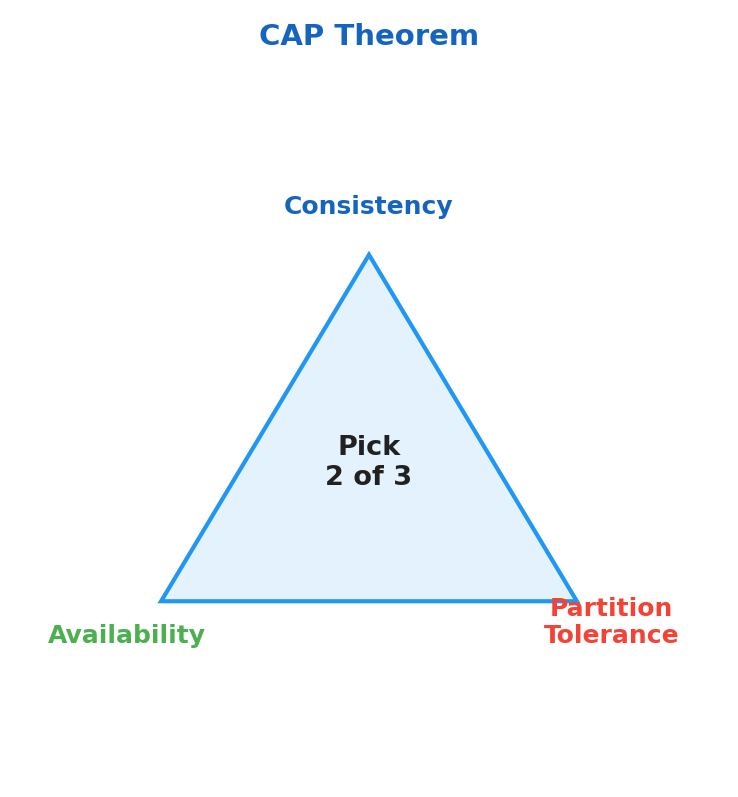
| Property | Description |
|---|---|
| Consistency | All replicas see the same data |
| Availability | System works under failure |
| Partition Tolerance | System continues operating with network partitions |
Systems can guarantee only two of the three properties at the same time.