MlOps
Architecture
In this project, I built a full-stack MLOps pipeline using AWS services and modern DevOps practices, integrating CI/CD pipelines, GitOps workflows, and Kubernetes deployment. Here’s a deep dive into how the whole system works, from data preprocessing to model deployment, all automated and infrastructure-as-code.
🚀 Overview
The pipeline focuses on a linear regression model trained on the California Housing dataset. It includes:
- AWS Glue for preprocessing
- EventBridge & Lambda for orchestration
- SageMaker for training and deployment
- Terraform for Infrastructure as Code
- GitHub Actions for CI/CD and GitOps
- Kubernetes (EKS) for frontend deployment
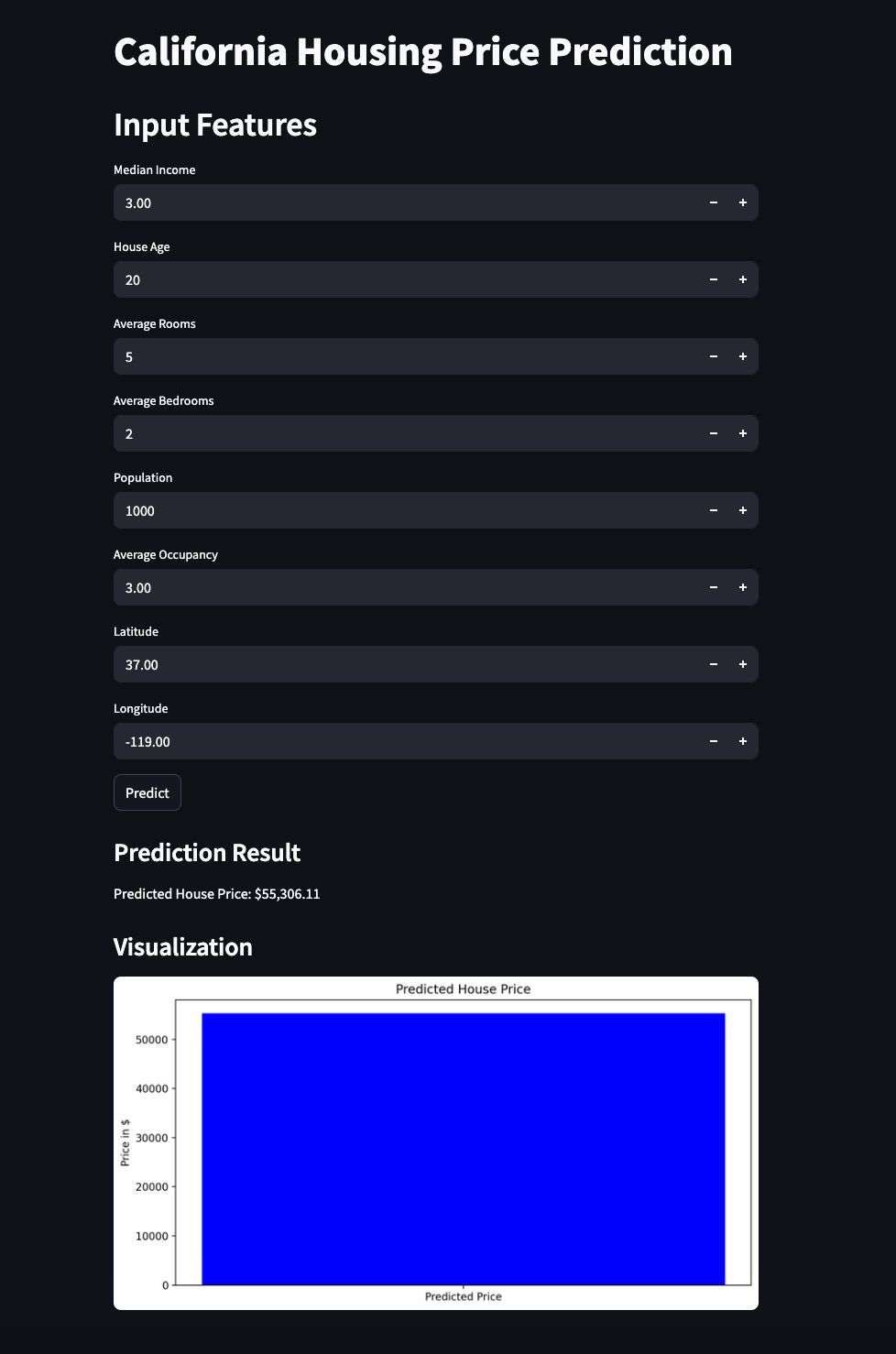
- Streamlit as a user-facing interface
🧱 System Architecture
🔄 ETL Pipeline with AWS Glue
- Raw housing data is uploaded to an S3 bucket.
- EventBridge detects the new file and triggers a Lambda function.
- Lambda starts a Glue workflow that runs a Python job to clean and transform the data.
- The processed data is saved to another S3 bucket for training.
🤖 MLOps with SageMaker Pipelines
- A second EventBridge rule detects the new preprocessed data and triggers a SageMaker pipeline.
- This pipeline:
- Executes additional transformations
- Trains a regression model using XGBoost
- Registers the model in SageMaker Model Registry
- Deploys it as a real-time endpoint
🌐 Model Serving and API
Once deployed, the model exposes a SageMaker endpoint. A lightweight REST API serves predictions via HTTP.
🧪 CI/CD for Frontend (Streamlit)
Every push to the frontend/ directory:
- Builds a Docker image via GitHub Actions
- Pushes the image to Amazon ECR
- Updates a Kubernetes deployment on EKS
- Exposes the app via an Ingress controller
This enables real-time user interaction and visualization.
⚙️ Infrastructure Automation with Terraform
All AWS resources, Glue, Lambda, S3, SageMaker, IAM, EventBridge, are managed via Terraform. The infrastructure code is modular, reusable, and version-controlled.
🌀 GitOps for IaC
Changes pushed to the iac/ directory:
- Trigger
terraform planandterraform applyvia CI/CD - Apply changes to the infrastructure using AWS credentials
- Enforce full GitOps compliance and reproducibility
☸️ Kubernetes Deployment for Frontend
Frontend deployment leverages Kubernetes for scalable serving:
- A Deployment pod runs the Dockerized Streamlit app.
- A Service exposes it internally.
- An Ingress route exposes it externally (e.g., via NGINX).
This structure allows secure, modular, and scalable user-facing components.
📈 Benefits of the Architecture
- Scalable: Serverless data processing and container-based serving
- Fully automated: CI/CD and GitOps reduce manual steps
- Repeatable: Terraform ensures consistent provisioning
- User-friendly: Streamlit frontend enables easy interaction
- Modular: Each stage can be reused or replaced independently
🔮 Future Work
- Add model monitoring (e.g., drift detection)
- Introduce approval gates before production deployment
- Expand to multi-model deployment patterns
- Integrate with ArgoCD for advanced GitOps
📎 References
If you’re looking to build production-grade MLOps pipelines or want to explore automation with AWS and Kubernetes, feel free to fork the project repository or drop your questions.
Stay open. Stay automated. 🚀